CD Ladder Strategy: How to Maximize Returns Without Locking Up All Your Cash
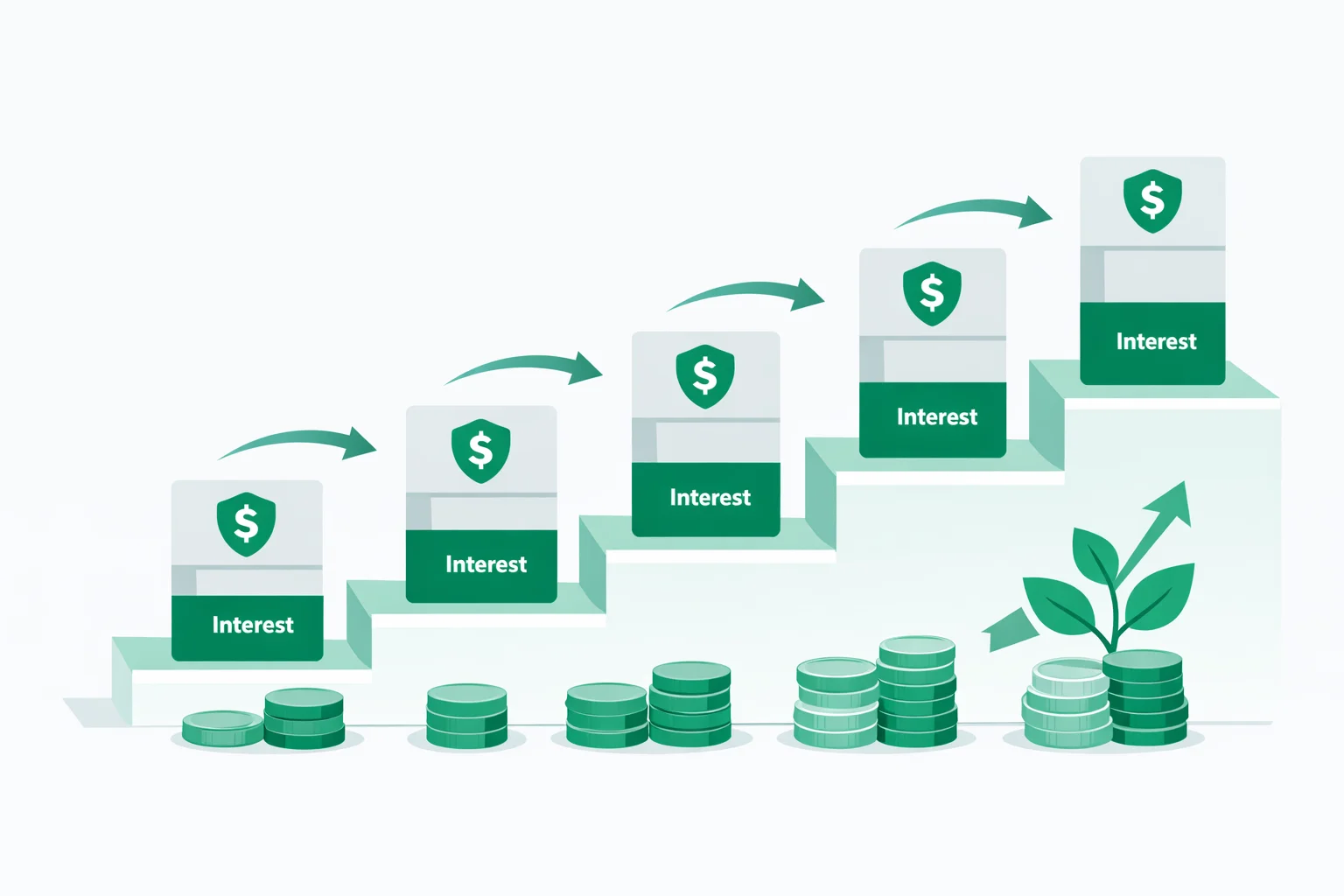
Split your deposit across multiple CDs with different terms so one matures every few months.
Longer-term CDs in your ladder capture premium rates while short-term rungs keep money accessible.
Each CD is FDIC-insured up to $250,000 per depositor, per bank—your ladder multiplies that coverage.
What Is a CD Ladder?
A CD ladder calculatorhelps you design a certificate of deposit strategy that balances earning higher interest rates with maintaining regular access to your money. Instead of locking your entire savings into a single long-term CD, you divide it across several CDs with staggered maturity dates—creating "rungs" on a ladder.
For example, with $25,000 and a 5-rung annual ladder, you would open five CDs of $5,000 each: a 1-year, 2-year, 3-year, 4-year, and 5-year CD. Each year when a CD matures, you either use the money or reinvest it into a new 5-year CD at the top of your ladder. After the first full cycle, every CD in your portfolio earns the higher 5-year rate while one matures annually.
This approach solves the core dilemma of CD investing: short-term CDs offer flexibility but lower rates, while long-term CDs pay more but lock your money away. A ladder gives you both. To see how individual CDs grow, try our CD interest calculator.
How CD Ladder Interest Is Calculated
Each rung in a CD ladder earns interest independently based on its APY and term. The formula for a single CD’s maturity value is:
Worked example: You invest $25,000 in a 5-rung annual ladder with APYs ranging from 4.50% (1-year) to 5.10% (5-year):
| Rung | Term | Deposit | APY | Interest | Maturity |
|---|---|---|---|---|---|
| 1 | 12 mo | $5,000 | 4.50% | $225 | $5,225 |
| 2 | 24 mo | $5,000 | 4.65% | $476 | $5,476 |
| 3 | 36 mo | $5,000 | 4.80% | $756 | $5,756 |
| 4 | 48 mo | $5,000 | 4.95% | $1,069 | $6,069 |
| 5 | 60 mo | $5,000 | 5.10% | $1,412 | $6,412 |
| Total | $25,000 | 4.80% | $3,938 | $28,938 | |
In this example, the weighted average APY across all rungs is 4.80%, and the ladder earns $3,938 in total interest. If you had put the entire $25,000 into a single 1-year CD at 4.50%, you would earn only $1,125—over $2,800 less. The tradeoff is that $20,000 stays locked for 2-5 years, but you still get $5,000 back every 12 months.
Key Factors That Affect Your CD Ladder Returns
- Number of rungs: More rungs mean more frequent access to cash but smaller deposits per CD. A 3-rung ladder gives you money every 12 months (with annual spacing); a 6-rung ladder gives money every 6 months.
- Rung spacing: Annual spacing (12 months) is most common. Semi-annual (6 months) improves liquidity. Quarterly (3 months) maximizes flexibility but usually sacrifices yield because short-term rates are lower.
- Rate environment: When the yield curve is steep (long-term rates much higher than short-term), laddering is especially powerful. In a flat or inverted yield curve, the advantage shrinks. Check current rates with our APY calculator to compare offers.
- Total investment size: FDIC insurance covers $250,000 per depositor per bank. With a $500,000 ladder, consider spreading across two banks to stay fully insured.
- Reinvestment strategy: When each rung matures, reinvesting into a new longest-term CD keeps the ladder running. Skipping reinvestment gradually collapses the structure.
CD Ladder vs Other Savings Strategies
How does a CD ladder compare to putting all your money in a single CD or a high-yield savings account? Here’s a side-by-side comparison using $25,000 over 5 years:
| Strategy | Liquidity | Typical APY | 5-Year Interest | Risk |
|---|---|---|---|---|
| CD Ladder (5-rung) | Yearly access | 4.50–5.10% | ~$3,938 | Very Low |
| Single 5-Year CD | None (60 mo lock) | 5.10% | ~$7,060 | Very Low |
| High-Yield Savings | Instant | 4.00–4.50% | ~$5,500* | Very Low |
| T-Bills (rolling) | 4-week cycles | 4.20–4.80% | ~$5,800* | Very Low |
*HYSA and T-Bill yields fluctuate with market rates. Estimates assume rates remain near current levels. CD rates are locked at purchase.
A single 5-year CD earns more total interest because the full $25,000 compounds at the highest rate for the longest time. But you cannot touch that money for 5 years without paying a penalty. A CD ladder sacrifices some interest in exchange for yearly liquidity—and still outperforms most savings accounts. Use our high-yield savings calculator to model the savings account alternative.
Common CD Ladder Mistakes to Avoid
Ignoring early withdrawal penalties
Breaking a 5-year CD early typically costs 6–12 months of interest. On a $5,000 CD at 5%, that’s $250–$500 lost. Always keep an emergency fund outside your ladder so you never need to break a CD.
Forgetting to reinvest at maturity
Many banks auto-renew matured CDs into a same-term CD—often at a lower promotional rate. Miss the 7–10 day grace period and you could be locked into a 0.5% rate for another year. Set calendar reminders 2 weeks before each maturity date.
Building a ladder when rates are falling
If rates drop from 5% to 3% over 2 years, your maturing short-term rungs reinvest at lower rates. In a falling-rate environment, a single long-term CD locks in today’s higher rate. Ladders work best when rates are stable or rising.
Exceeding FDIC limits at one bank
Each bank insures only $250,000 per depositor. A $300,000 ladder at one bank leaves $50,000 uninsured. Split large ladders across multiple FDIC-insured institutions.
Optimal CD Ladder Configurations by Goal
The best ladder structure depends on your financial goals and how soon you might need the money:
Emergency fund extension (3-rung, 6-month spacing)
Keep 3–6 months of expenses in a savings account, then ladder the rest in 6-month, 12-month, and 18-month CDs. You access one rung every 6 months while earning 0.3–0.5% more than a savings account.
Maximum yield (5-rung, 12-month spacing)
The classic configuration. Open 1-year through 5-year CDs. After year one, reinvest each maturing CD into a new 5-year CD. Within 5 years, every rung earns the 5-year rate while one matures annually.
Down payment savings (3-rung, 12-month spacing)
Planning to buy a house in 1–3 years? Split your down payment fund into 1-year, 2-year, and 3-year CDs. Each rung matures closer to when you might need it, and you earn more than a savings account while you wait. Model your future home costs with our mortgage calculator.
Tax Implications of CD Ladder Interest
CD interest is taxed as ordinary income in the year it is earned—not when the CD matures. For a $5,000 CD earning 5% APY, the bank reports approximately $250 on a 1099-INT each year. In the 22% federal tax bracket, that’s $55 in tax on each rung’s annual interest.
A 5-rung ladder generating $1,500/year in total interest would owe roughly $330 in federal tax at the 22% bracket. State taxes may apply too—check your state’s treatment of interest income. One advantage: unlike bonds or stocks, CD interest timing is predictable, making tax planning straightforward.
Consider holding CD ladders inside an IRA to defer or eliminate taxes on interest. A Roth IRA CD ladder is especially powerful: the interest grows tax-free and withdrawals in retirement are tax-free. Use our compound interest calculator to see how tax-free compounding accelerates growth.
Tips for Building a Better CD Ladder
Shop multiple banks for each rung. Online banks typically offer 0.25–0.75% higher APY than brick-and-mortar banks. On a $5,000 rung over 5 years, that’s an extra $63–$190 in interest.
Consider credit union CDs. Credit unions call them "share certificates" and often beat bank rates by 0.10–0.30%. They’re insured by NCUA up to $250,000—equivalent to FDIC.
Use no-penalty CDs for the shortest rung. Some banks offer no-penalty CDs at slightly lower rates (0.10–0.20% less). The flexibility to withdraw early without penalty can be worth the small rate reduction.
Set maturity alerts 14 days early. Banks give a 7–10 day grace period after maturity. Miss it and your CD auto-renews—potentially at a much lower rate. A 2-week advance reminder gives you time to shop rates.
Align rungs with known expenses. If you pay property taxes in June and December, time two rungs to mature in May and November. Your money earns CD rates instead of sitting in checking.
When to Use a CD Ladder Calculator
- You have $5,000+ in savings beyond your emergency fund and want guaranteed returns higher than a savings account without stock market risk.
- You want predictable income. Retirees and conservative investors use CD ladders to generate regular, risk-free cash flow from their savings.
- Rates are stable or rising. When the Fed holds or raises rates, new rungs lock in progressively better rates. If rates are expected to drop, a single long-term CD may be smarter.
- You’re saving for a specific goal in 1–5 years—like a home down payment, a car, or a wedding—and want to earn more than a savings account while maintaining some flexibility.
Bottom line:A CD ladder won’t beat stock market returns over decades, but it’s one of the safest strategies for money you need within 1–5 years. The calculator above lets you model different rung counts, spacing, and rates to find the configuration that matches your timeline and goals.